

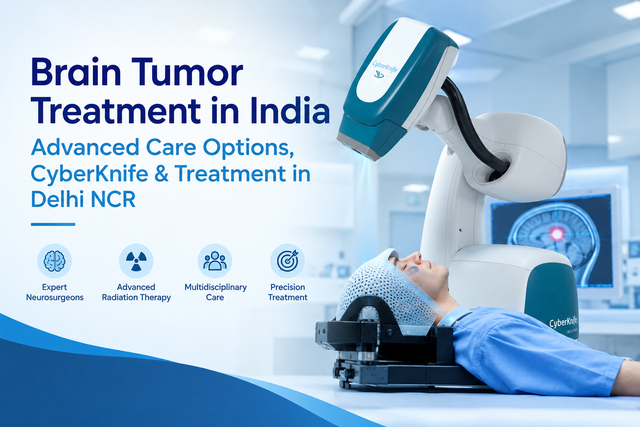
A brain tumor is an abnormal growth of cells in or around the brain that can be benign (non-cancerous) or malignant (cancerous). Because the brain controls vital functions such as movement, speech, memory, vision, and coordination, brain tumors require timely evaluation and specialized treatment.
Today, patients looking for Brain Tumor Treatment in India have access to advanced diagnostic facilities, experienced neurosurgeons, radiation oncologists, medical oncologists, and modern radiation technologies. Depending on the tumor type, size, location, symptoms, and overall health, treatment may include surgery, radiation therapy, chemotherapy, targeted treatment, or a combination of approaches.
For patients seeking Brain Tumor Treatment in Delhi NCR, specialized cancer centers offer multidisciplinary care and advanced radiation techniques such as stereotactic radiosurgery. One such technology is CyberKnife, which can deliver highly precise radiation to selected brain tumors while minimizing radiation exposure to surrounding healthy tissue.
What Is a Brain Tumor?
A brain tumor develops when cells grow abnormally within the brain or surrounding structures. Brain tumors may originate in the brain itself or spread to the brain from another part of the body. These are commonly categorized as:
- Benign brain tumors: Generally slow-growing and non-cancerous, although they can still cause serious problems by pressing against important brain structures.
- Malignant brain tumors: Cancerous tumors that may grow more aggressively and invade surrounding tissue.
- Primary brain tumors: Tumors that begin in the brain or nearby structures.
- Metastatic brain tumors: Cancers that have spread to the brain from another organ.
Treatment depends on the specific diagnosis rather than simply whether a tumor is benign or malignant.
Symptoms of Brain Tumors
Symptoms can vary significantly depending on the tumor’s location, size, and growth rate. Common symptoms may include:
- Persistent or worsening headaches
- Nausea or vomiting
- Seizures
- Changes in vision
- Difficulty speaking or understanding speech
- Problems with balance or coordination
- Weakness or numbness in an arm or leg
- Memory or concentration difficulties
- Personality or behavioral changes
Having these symptoms does not necessarily mean a person has a brain tumor. However, persistent or unexplained neurological symptoms should be evaluated by a qualified medical professional.
Diagnosis Before Brain Tumor Treatment
Accurate diagnosis is an essential first step in determining the most appropriate treatment. Doctors may recommend neurological examination and imaging investigations such as MRI or CT scans.
In some cases, a biopsy or surgical procedure may be required to determine the tumor’s type and grade. Specialists also consider factors such as tumor location, size, molecular characteristics, symptoms, previous treatment, and the patient’s overall health.
This detailed assessment helps create an individualized treatment plan.
Brain Tumor Treatment in India
Brain Tumor Treatment in India may involve one or more treatment approaches. The choice depends on the individual patient’s diagnosis and clinical condition.
1. Surgery
Surgery may be recommended when a tumor can be safely accessed. Depending on its location and characteristics, the objective may be to remove as much of the tumor as safely possible, obtain tissue for diagnosis, or relieve pressure on the brain.
The extent of surgery varies from patient to patient. In some situations, complete removal may be possible, while in others, preserving important neurological functions may take priority.
2. Radiation Therapy
Radiation therapy uses high-energy radiation to damage the DNA of tumor cells and control their growth. It may be used after surgery, as the primary treatment for selected tumors, or to manage recurrent or metastatic disease.
Modern radiation techniques are designed to improve treatment precision and protect surrounding healthy structures as much as possible.
3. Chemotherapy and Systemic Treatment
Certain brain tumors may require chemotherapy or other systemic treatments. The choice depends on the tumor’s pathology and molecular characteristics. These treatments may be used alone or alongside surgery and radiation therapy.
4. Stereotactic Radiosurgery
Stereotactic radiosurgery (SRS) is a highly precise radiation treatment that delivers focused radiation to a defined target. Despite the name, radiosurgery does not involve making a surgical incision.
SRS can be considered for selected brain tumors and other intracranial lesions, depending on factors such as tumor size, location, number of lesions, previous treatment, and overall health.
Brain Tumor Treatment with CyberKnife
Brain Tumor Treatment with CyberKnife is an advanced radiation treatment option for appropriately selected patients. CyberKnife is a robotic stereotactic radiation system designed to deliver highly focused radiation from multiple angles.
The system uses image guidance during treatment to help accurately target the treatment area. This precision is particularly important when treating lesions located close to sensitive structures.
How CyberKnife Works
During CyberKnife treatment, imaging technology helps identify the target and guide radiation delivery. The robotic system can direct radiation beams from different positions around the patient.
The goal is to deliver an effective radiation dose to the tumor while reducing unnecessary radiation exposure to surrounding healthy tissue.
Depending on the treatment plan, CyberKnife treatment may be delivered over one or several sessions. The number of sessions is determined by the treating radiation oncology team based on the individual case.
CyberKnife for Brain Tumor: Who May Benefit?
CyberKnife for Brain Tumor may be considered for selected patients with conditions such as certain small or well-defined brain tumors, brain metastases, recurrent tumors, or other intracranial lesions.
However, CyberKnife is not automatically suitable for every brain tumor. Factors that may influence treatment selection include:
- Tumor size
- Tumor location
- Number of lesions
- Tumor type and grade
- Previous surgery or radiation therapy
- Patient’s neurological condition
- Overall health
- Relationship of the tumor to critical brain structures
A specialist evaluation is therefore essential before deciding whether CyberKnife is appropriate.
Advantages of CyberKnife for Selected Brain Tumors
One of the important advantages of stereotactic radiation is its ability to deliver highly focused treatment. Depending on the patient’s condition, potential benefits may include:
- Precise radiation delivery
- Non-invasive treatment
- No surgical incision
- Treatment delivered in one or multiple sessions depending on the case
- Reduced exposure of surrounding healthy tissue
- Potentially shorter treatment courses compared with some conventional radiation schedules
These advantages make CyberKnife an important option in the treatment planning of selected intracranial tumors.
Brain Tumor Treatment in Delhi NCR
For patients searching for Brain Tumor Treatment in Delhi NCR, access to multidisciplinary cancer care can be an important consideration.
At Valentis Cancer Hospital, patients can undergo specialist evaluation to determine an appropriate treatment strategy based on their diagnosis and individual requirements.
The hospital provides information about brain tumor treatment and advanced radiation therapy options through its dedicated brain tumor treatment service page.
Why Choosing the Right Treatment Matters
Brain tumor treatment should never be based on the tumor name alone. Two patients with the same broad diagnosis may require different approaches because their tumors can differ in location, size, molecular characteristics, symptoms, and previous treatment history.
A multidisciplinary treatment plan can help specialists evaluate all available options and determine whether surgery, conventional radiation therapy, stereotactic radiosurgery, CyberKnife, systemic therapy, or a combination of treatments is appropriate.
Patients should discuss the potential benefits, limitations, side effects, and expected outcomes of each treatment option with their medical team.
Frequently Asked Questions About Brain Tumor Treatment
1. What is the best treatment for a brain tumor?
There is no single treatment that is best for every brain tumor. Treatment depends on tumor type, grade, size, location, symptoms, molecular characteristics, and the patient’s overall health.
2. Is CyberKnife suitable for every brain tumor?
No. CyberKnife for Brain Tumor is suitable only for selected cases. Tumor size, location, number of lesions, previous treatments, and proximity to sensitive structures are important considerations.
3. Is CyberKnife a surgery?
No. CyberKnife is a non-invasive radiation treatment. It does not require a conventional surgical incision.
4. How many CyberKnife sessions are needed?
The number of sessions varies according to the tumor and treatment plan. Some patients may require a single session, while others may need multiple sessions.
5. Can brain tumors be treated without surgery?
In selected cases, yes. Radiation-based treatments such as stereotactic radiosurgery may be considered depending on the tumor’s characteristics. However, surgery may still be necessary for diagnosis, decompression, or tumor removal in other cases.
6. Where can I seek Brain Tumor Treatment in Delhi NCR?
Patients can consult a specialized cancer center such as Valentis Cancer Hospital for comprehensive evaluation and individualized treatment planning.
Advances in cancer care have expanded treatment options for patients diagnosed with brain tumors. Brain Tumor Treatment in India may involve surgery, radiation therapy, chemotherapy, targeted treatment, or a combination of approaches depending on the diagnosis.
For appropriately selected patients, Brain Tumor Treatment with CyberKnife can provide a highly precise, non-invasive radiation treatment option. CyberKnife for Brain Tumor may be particularly useful when focused radiation is appropriate based on tumor size, location, and other clinical factors.
Patients searching for Brain Tumor Treatment in Delhi NCR should seek evaluation from an experienced multidisciplinary team. At Valentis Cancer Hospital, specialists can assess the individual case and recommend a treatment approach based on the patient’s medical condition and treatment goals.
