Superior Tumor Control
Daily imaging allows doctors to see tumor shrinkage daily, enabling them to limit the dose to the tumor/cancer rather than healthy tissue. This results in fewer complications and far superior tumor control.

Valentis Cancer Hospital is equipped with state-of-the-art radiotherapy equipment. Radiation oncology is a branch of medical specialty that uses ionizing radiation in the form of x-rays to treat cancer patients and some noncancerous conditions.
The TomoTherapy System is intended to deliver image-guided, intensity-modulated radiation therapy (IG-IMRT) for the treatment of cancer and other diseases in a safe and routine manner. The integration of a computed tomography (CT) scanner to perform daily imaging before each treatment session distinguishes the TomoTherapy System from conventional radiation systems.
The daily imaging capability allows clinicians to detect and correct for changes in patient positioning, tumor changes, or other factors such as weight gain or loss, ensuring the continued precise as well as safe delivery of the radiation dose to the target area. Because the TomoTherapy System's precision reduces radiation exposure to surrounding healthy tissue.
Many doctors report that their patients have fewer side effects than patients who receive traditional forms of radiation therapy.
Because of the precision, the TomoTherapy System may be used to treat patients who have previously received radiation therapy if their cancers have returned using the re-treatment functionality.
Radiation beams must pass through the body to reach and exit the treatment area.
The system's design limits the angles from which radiation can be delivered.
Some radiation may affect healthy tissue near the tumor due to movement during treatment.
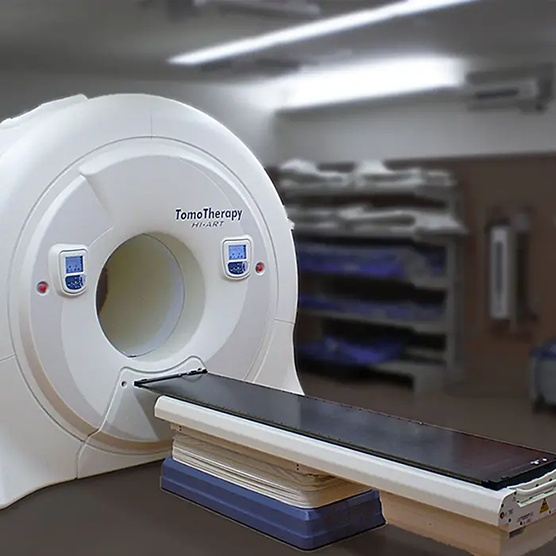
Tomotherapy delivers continuous radiation from 360 degrees around the patient or clinician-specified beam angles. These distinguishing characteristics, when combined with daily 3D image guidance, enable physicians to deliver highly accurate, individualized dose distributions that precisely conform to the shape of the patient's tumor while minimizing the dose to normal, healthy tissue, resulting in fewer side effects for patients. The system aids in the treatment of all standard radiation therapy indications, including breast, prostate, lung, and head and neck cancers, as well as complex treatments like total marrow irradiation.
Daily imaging allows doctors to see tumor shrinkage daily, enabling them to limit the dose to the tumor/cancer rather than healthy tissue. This results in fewer complications and far superior tumor control.
Low CT imaging dose with iterative imaging enables patients with metal implants (dentures, pacemakers, orthopedic implants) to receive highly accurate treatments, as imaging can be performed without artifacts.
High local tumor control with low dose to healthy tissue and normal organs such as eyes, lungs, heart, kidneys, parotid glands, and other vital organs.
High survival rate with fewer radiation complications or side effects. Targeted treatments become a reality as dose is restricted to the tumor.
Fewer radiation complications or side effects. Even complicated and pediatric treatments can be performed with confidence.
