

A diagnosis of liver cancer can make treatment decisions feel urgent and overwhelming. However, choosing the right centre is an important part of the treatment journey. The liver cancer best hospital in India is not defined by one machine, one doctor or one treatment alone; it should provide accurate diagnosis, multidisciplinary expertise, individualised treatment planning and reliable long-term follow-up.
Liver cancer treatment can be complex because the liver has essential functions, and many patients may also have conditions such as cirrhosis, hepatitis B or hepatitis C, fatty liver disease, or reduced liver function. The most suitable treatment depends on the cancer stage, tumour number and size, location, liver health, spread outside the liver and the patient’s overall condition.
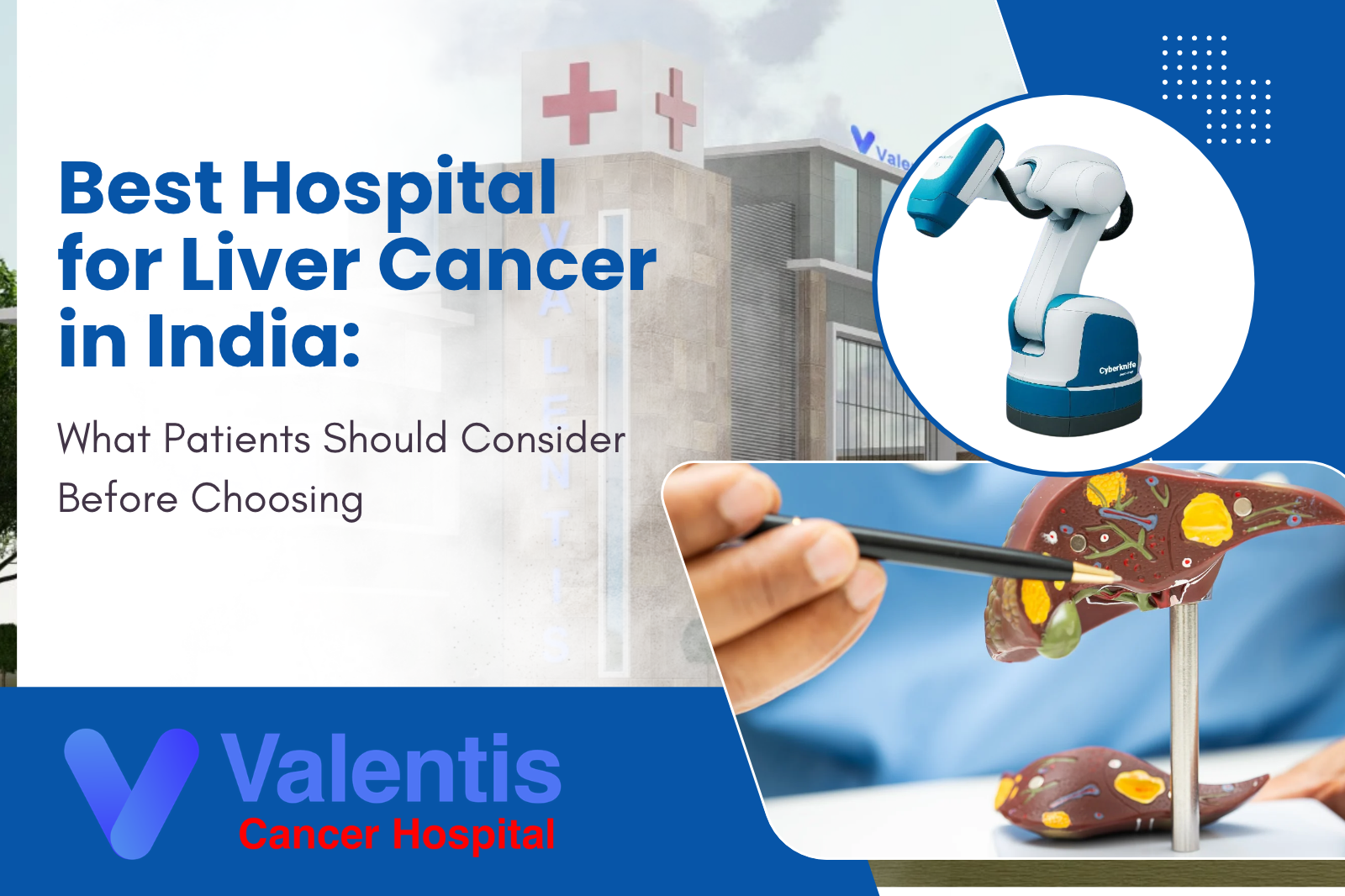
At Valentis Cancer Hospital, patients can access comprehensive cancer-care support and advanced radiation options, including CyberKnife S7, as part of an individualised liver cancer treatment plan.
Why Specialised Liver Cancer Care Matters
Primary liver cancer, particularly hepatocellular carcinoma (HCC), requires careful assessment because treatment decisions depend on both the tumour and the condition of the remaining liver. In some patients, a tumour may be technically removable, but poor liver reserve can make major surgery unsafe. In others, local treatment may be appropriate even when surgery is not possible.
The National Cancer Institute lists surgery, liver transplantation, ablation, embolisation, targeted therapy, immunotherapy and radiation therapy among the potential treatment approaches for primary liver cancer. The most appropriate option depends on the individual clinical situation.
A hospital should therefore evaluate more than imaging reports alone. A complete liver cancer assessment may include:
- Contrast-enhanced CT scan, MRI or PET-CT when clinically indicated.
- Liver-function tests and blood investigations.
- AFP and other relevant tumour-marker assessments.
- Evaluation for cirrhosis, portal hypertension and viral hepatitis.
- Biopsy when imaging and clinical findings do not provide a clear diagnosis.
- Assessment of whether the disease is confined to the liver or has spread elsewhere.
- Review by multiple specialists before finalising treatment.
This thorough approach helps avoid a one-size-fits-all treatment decision and supports safer care planning.
Look for a Multidisciplinary Team
When searching for the liver cancer best hospital in India, patients should ask whether their case will be reviewed by a multidisciplinary tumour board. Liver cancer management often requires coordinated decisions from several medical specialties.
A strong liver cancer team may include:
- Surgical oncologists or hepatobiliary surgeons.
- Medical oncologists.
- Radiation oncologists.
- Hepatologists or gastroenterologists.
- Interventional radiologists.
- Diagnostic radiologists.
- Pathologists.
- Nuclear medicine specialists.
- Nutritionists, pain specialists and palliative-care professionals.
The NCCN patient guidelines emphasise that liver cancer treatment should involve a multidisciplinary team. They also identify surgery, ablation, arterially directed therapy and radiation therapy among the treatment approaches used according to a patient’s diagnosis and clinical suitability.
This team-based model is important because a patient may need more than one form of treatment. For example, an individual may receive TACE to control tumour blood supply, followed by radiation therapy for a residual lesion, or systemic treatment before reassessment for local therapy.
Assess the Range of Treatments Available
The best cancer hospital in India should be able to discuss all appropriate treatment choices rather than promote a single technology for every patient. Depending on the stage and liver function, liver cancer treatment in India may include:
| Treatment approach | When it may be considered |
|---|---|
| Surgical resection | For selected patients with localised tumours and adequate liver reserve |
| Liver transplantation | For eligible patients meeting specific clinical criteria |
| Thermal ablation | For selected small tumours where heat or cold can destroy cancer cells |
| TACE or embolisation | For tumours not suitable for curative surgery or ablation, especially when disease remains within the liver |
| Radiation therapy | For selected tumours that cannot be safely treated with surgery or other local methods |
| Targeted therapy or immunotherapy | For advanced, recurrent or metastatic disease, depending on tumour profile and patient health |
| Supportive and palliative care | To manage symptoms, nutrition, pain and quality of life at every stage |
The NCI notes that transarterial embolisation and chemoembolisation are widely used options for HCC that cannot be treated with curative surgery or ablation, provided the disease situation and liver function permit it.
A patient should be cautious if a hospital recommends any treatment without reviewing liver function, tumour biology, imaging and alternative options.
Understanding CyberKnife S7 for Liver Cancer
CyberKnife S7 is a robotic stereotactic body radiation therapy system that delivers focused radiation beams to a tumour from multiple angles. The technology is particularly relevant for liver tumours because the liver moves with breathing.
During cyberknife treatment for liver cancer, image guidance and respiratory-motion tracking are used to help align radiation delivery with the moving tumour. Valentis Cancer Hospital states that CyberKnife S7 can continuously track respiratory movement and adjust beam delivery, with the aim of concentrating radiation on the tumour while limiting exposure to healthy liver tissue.
CyberKnife S7 may be considered for selected patients who:
- Have unresectable liver tumours.
- Are not suitable candidates for surgery because of health risks or tumour location.
- Have a limited number of liver metastases.
- Have residual or recurrent disease after prior treatment.
- Need a non-invasive local treatment approach.
- Have adequate liver function and enough healthy liver tissue for safe planning.
Treatment is generally delivered over a limited number of sessions. Valentis Cancer Hospital notes that an individual CyberKnife S7 liver-treatment plan may involve one to five sessions, depending on the tumour and clinical requirements.
CyberKnife is not right for every patient. Tumour size, number of lesions, proximity to sensitive organs, liver reserve, previous radiation and cancer spread must all be assessed before treatment. A review of SBRT for liver metastases describes common selection considerations such as limited liver lesions, controlled disease outside the liver, adequate healthy liver volume, good performance status and appropriate liver function.
Questions to Ask Before Choosing
Before finalising a liver cancer hospital, patients and caregivers should ask practical questions:
- Is my tumour primary liver cancer or cancer that has spread to the liver?
- What is my cancer stage, and how well is my liver functioning?
- Will my case be discussed in a multidisciplinary tumour board?
- Is surgery possible, and if not, why?
- Am I eligible for ablation, TACE, Y-90, transplant evaluation, systemic therapy or radiation?
- Is CyberKnife S7 clinically suitable for my tumour, or are other options safer?
- How many treatment sessions may be required?
- What short-term and long-term side effects should I expect?
- What costs are included in the treatment estimate?
- What follow-up scans, liver tests and consultations will be required?
Clear answers to these questions can help patients make informed decisions rather than selecting a centre based only on advertisements, distance or equipment claims.
Choosing Valentis Cancer Hospital
The liver cancer best hospital in India should provide personalised care, transparent communication and access to appropriate treatment pathways. Valentis Cancer Hospital offers advanced radiation oncology services, including CyberKnife S7, for selected liver-tumour cases. Its clinical team evaluates imaging, tumour characteristics, liver function and the patient’s overall health before recommending treatment.
For some patients, surgery or transplantation may offer the best route. For others, ablation, embolisation, systemic therapy or precise radiation may be more appropriate. The right hospital will explain these distinctions honestly and create a care plan that prioritises both cancer control and preservation of liver function.
